
Foundation Connections

A Career Shaped by Learning
Published 7/24/2026
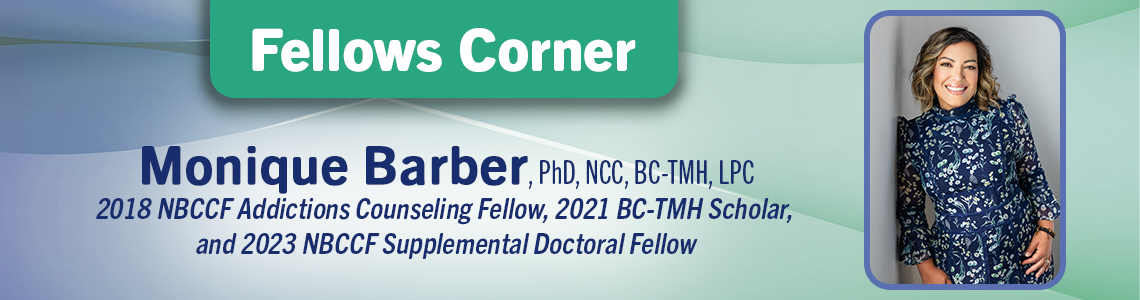
Dr. Monique Barber understands that professional growth rarely happens all at once. Instead, it develops through experiences that build confidence, expand perspectives, and encourage Counselors to step into opportunities they may not have imagined for themselves.
As the recipient of the 2018 NBCCF Fellowship for Addictions Counseling (MFP-AC), the 2021 Board Certified-TeleMental Health Provider (BC-TMH) Training Award, and the 2023 NBCCF Supplemental Doctoral Fellowship for Mental Health Counseling (MFP-MHC-D), Dr. Barber has experienced firsthand how continued learning can shape both a career and the quality of care provided to clients.
Looking back, Dr. Barber credits the MFP-AC fellowship experience with helping her envision possibilities that had once felt beyond reach. Opportunities to attend the NBCCF Bridging the Gap Symposium introduced her to Fellows who had gone on to pursue doctoral degrees and leadership positions. Those experiences reshaped how she viewed her own future. Each Symposium became more than a learning opportunity; she returned home eager to share new ideas with colleagues and supervisors while building confidence in her own abilities.
“It bolstered my confidence in a way that I’m not sure I could have done independent of the MFP Award,” says Dr. Barber.
Dr. Barber saw the fellowship as just the beginning. She pursued the BC-TMH Training Award offered by NBCCF, in partnership with the Center for Credentialing & Education (CCE). The training award offered her the opportunity to receive the necessary training to obtain the BC-TMH credential.
The BC-TMH credential has influenced her clinical practice while creating opportunities to teach and mentor others. Recently, she led a telemental health workshop at Boise State University, a role that specifically sought someone with the BC-TMH credential. During that workshop, Dr. Barber discovered that several of the students were also NBCCF Addictions Counseling Fellows.
“It’s like learning I have a new cousin on a DNA website!” exclaims Dr. Barber.
Moments like that remind Dr. Barber of the lasting connections created through fellowship experiences. They also reinforce the value of continuing to invest in professional growth throughout careers.
Today, telehealth has become an important part of her practice. About half of her clients choose virtual sessions, and she appreciates the flexibility that allows them to continue receiving care even when unexpected situations arise. Telehealth offers an option that helps remove barriers to care without compromising the therapeutic relationship.
Dr. Barber has found that this flexibility is especially valuable when working with couples and families. Coordinating schedules for multiple people can sometimes become the biggest obstacle to beginning Counseling. Virtual sessions help reduce those logistical challenges, allowing clients to focus their energy on the work they came to do rather than the difficulty of simply getting everyone into the same room.
“I especially like telehealth for couples,” says Dr. Barber. “The amount of planning and scheduling that has to happen to get a couple or a family together for a session can be enough of a barrier to prevent them from starting.”
While some Counseling professionals remain hesitant about providing services virtually, Dr. Barber encourages them to approach telehealth with an open mind. She understands that developing confidence with a new way of practicing takes time but believes quality training can make a significant difference.
“There are pros and cons to telehealth, but then again, there are pros and cons to most things in life,” she says.
Rather than focusing on what feels unfamiliar, Dr. Barber recommends building competence through education and preparation. If there is doubt, she believes additional training and self-care protocols are likely to reduce that mental “friction.”
Dr. Barber also emphasizes the importance of establishing clear expectations with clients from the beginning. Conversations during informed consent help create shared expectations and strengthen the therapeutic foundation. Discussing expectations verbally, in addition to written documentation, allows Counselors to establish healthy boundaries while helping clients understand the structure of the Counseling relationship.
Beyond her clinical work, Dr. Barber continues investing in the future of the profession. She recently completed and defended her dissertation and is expanding her group practice. Her goal is to create a mentoring environment for recently licensed Counselors that reflects the encouragement, guidance, and sense of community she experienced through the NBCCF Fellowship Program.
“My dream for expanding was to offer a mini-fellowship experience for recently licensed Counselors,” says Dr. Barber.
Through teaching, presenting, and participating in Mission 43, a nonprofit that supports military members, veterans, and spouses transitioning to civilian life, Dr. Barber has developed a deeper appreciation for the challenges and responsibilities of leading others. She is also candid about the reality that professional growth is rarely perfect.
“I make a lot of mistakes,” she admits. “This is the thing about doing things that scare us. You will make mistakes. But that’s not the issue. The secret to making mistakes is to learn from them and keep going!”
When asked what she would say to Counselors considering applying for the BC-TMH Provider Training Award, her response was immediate.
“Do it!”
Dr. Barber knows firsthand how one opportunity can lead to another. The training award did more than help add credentials to her resume. It expanded her leadership opportunities, connected her with a supportive professional community, and increased her access to care for clients.
As telemental health continues to evolve, Dr. Barber hopes more Counselors will embrace the training and support available to them, recognizing that each new opportunity has the potential to shape not only their own careers, but also the lives of the clients and communities they serve.
Monique Barber, PhD, NCC, BC-TMH, LPC, received her BS from Boise State University, her MS from Northwest Nazarene University, and her PhD from Liberty University. She is a 2018 NBCCF Addictions Counseling Fellow, a 2021 BC-TMH Scholar, and a 2023 NBCCF Supplemental Doctoral Fellow.
To learn more about the BC-TMH Training Award and other professional development awards, or to explore ways to get involved with NBCCF, please contact the Foundation at foundation@nbcc.org .
Share Article


